Peptide PEGylation: Enhancing Therapeutic Performance
Jump to section
PEGylation, the covalent attachment of polyethylene glycol (PEG) chains to peptides, has become a pivotal strategy for enhancing the therapeutic performance of peptide-based drugs. By increasing solubility, prolonging circulating half-life, and reducing immunogenicity, PEGylation addresses key limitations that have historically constrained the clinical use of peptides. Building on these advantages and our technical expertise, our laboratory provides tailored PEG–peptide synthesis services, enabling the rational design and production of PEGylated peptide conjugates that meet demanding quality requirements for modern drug development and the development of more stable peptide therapeutics. Learn more about the principles, benefits, and practical considerations of peptide PEGylation in this article, download the PDF version or contact us to find out more about our services.
Why Are Peptides Attractive Candidates for Drug Discovery?
Peptides are highly selective and potent biomolecules capable of modulating specific biological pathways with remarkable precision and minimal toxicity. Naturally derived peptides, such as those found in animal venom, marine organisms and plants,[1] exhibit complex and tightly regulated biological functions, making them a valuable source of inspiration for drug discovery.
Advances in structural biology and analytical techniques, including high-resolution mass spectrometry and protein sequencing, combined with modern solid-phase peptide synthesis (SPPS), have enabled the efficient production of bioactive peptides for research and therapeutic applications. Furthermore, rational peptide design through modification of native sequences or the creation of de novo peptide mimetics has significantly expanded the repertoire of peptides with potential clinical utility.
What Limitations Do Unmodified Peptide Drugs Face?
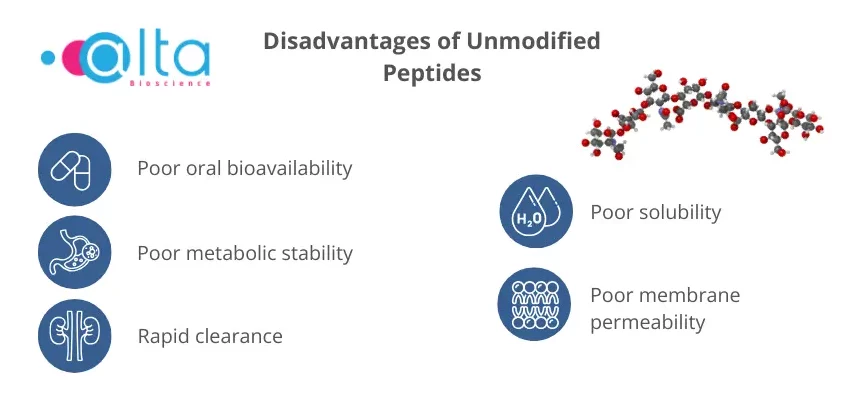
Despite their promise, unmodified peptides face challenges such as:
- Rapid enzymatic degradation and poor bioavailability: Many peptides are quickly broken down by proteases and peptidases in the body, which limits the duration of their therapeutic effect.
- Rapid clearance: Their small size often leads to rapid renal clearance, preventing them from remaining in circulation long enough to achieve optimal activity.
However, structural modifications (such as peptide cyclisation or peptide conjugation with PEG) have been used to address these limitations and improve their pharmacological profiles.
Why Use PEGylated Peptides?
Protecting Proteins with PEGylation
PEGylation emerged in the 1970s as a bioconjugation technique designed to modify proteins for pharmaceutical applications. Its first reports, published in 1977 by Davis and Abuchowski, described the covalent attachment of polyethylene glycol (PEG) to bovine serum albumin and liver catalase to reduce immunogenicity and prolong circulation time.[2,3] The primary goal was to create “stealth” therapeutics by shielding proteins from immune recognition and enzymatic degradation, and hence improving pharmacokinetics of therapeutic proteins, a principle later extended to drug delivery carriers such as liposomes, nanoparticles and peptides.[4]
Advantages of Peptide Pegylation
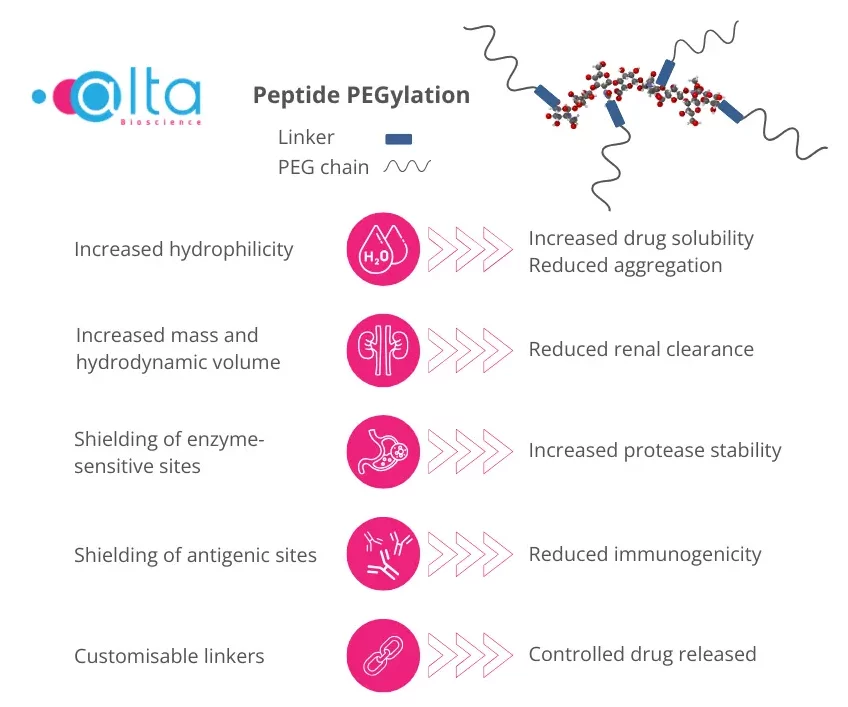
- Shielding and stability: Polyethylene glycol increases the apparent molecular size of the peptide and reduces exposure of the core sequence to the surrounding biological environment, thereby shielding them from immune recognition and enzymatic degradation.
- Extended circulation and patient benefits: As a result, PEG peptides often maintain their presence in the body for a longer period of time. From a patient perspective, this provides the benefit of less frequent dosing and more consistent therapeutic effects, which can improve adherence to treatment.
- Increased peptide solubility and reduced aggregation: However, these are not the only benefits. PEG conjugation also improves peptide solubility by introducing hydrophilic chains that interact with water and mask hydrophobic regions, while minimising aggregation through steric hindrance that limits intermolecular interactions.
A notable example is pegcetacoplan, a PEGylated peptide therapeutic used to treat paroxysmal nocturnal hemoglobinuria (PNH). Its PEG conjugation confers greater stability, a prolonged circulating half-life, and reduced immunogenicity, resulting in improved therapeutic outcomes and greater convenience for patients.[5]
Peptide PEGylation Method
Peptide PEGylation is the process in which polyethylene glycol is covalently linked to a peptide through a selected functional group. The approach can be adapted for different molecular designs.
Types of Polyethylene Glycol Used
PEG type and polymerisation
The type of polyethylene glycol structure employed depends on the desired properties of the final conjugate. Polyethylene glycol is generally produced through polymerisation of ethylene oxide, which creates repeating ethylene oxide units, forming chains of different lengths. Control of this polymerisation process influences the average molecular weight and the distribution of chain sizes.
PEG architectures
Common forms include linear polyethylene glycol, branched polyethylene glycol, and multi arm polyethylene glycol.
Methoxy terminated polyethylene glycol often called mPEG is frequently selected because its terminal methoxy group blocks further reaction at that end, while the opposite end remains available for controlled activation.
Functional end group modifications
Beyond methoxy termination, polyethylene glycol can be modified with a variety of functional end groups such as amine, carboxyl, aldehyde, or maleimide groups. These options allow researchers to match the polyethylene glycol structure with the type of chemistry they plan to use for attachment.
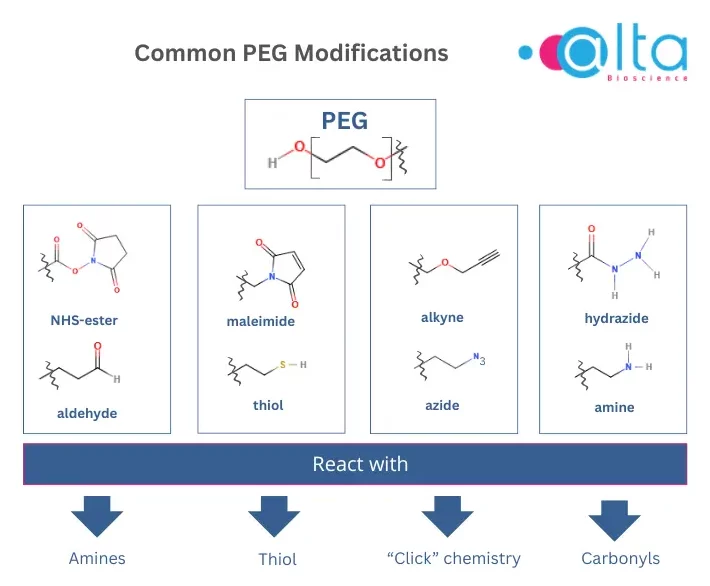
Taken together, the different architectures and end group modifications allow adjustment of attributes such as size, flexibility, and hydrophilicity which influences the final performance of the conjugate.[6]
Formation of PEG-Peptide Conjugates
Attachment of polyethylene glycol to a peptide can occur at different positions along the sequence.
- Random attachment usually targets common nucleophilic groups such as the amino group at the peptide terminus or the side chains of lysine residues. This approach is simple but often produces a mixture of products with varying levels of activity.
- Site specific attachment provides greater control because the modification is directed to a single predefined location. This is often achieved through selective chemistries that recognise a unique residue, such as a cysteine, or through the introduction of a specially designed tag that guides the conjugation event.
What Factors Affect PEGylated Peptide Performance?
The performance of PEG-peptides depends on several interrelated factors, each influencing pharmacokinetics, stability, and biological activity of the peptides. Understanding these variables is critical for designing optimised peptide therapeutics.
Molecular Weight and Structure
The molecular weight of the conjugated PEG chain is a primary determinant of the pharmacokinetic and pharmacodynamic profile, influencing renal clearance, tissue distribution, and circulation half‑life. Low molecular weight PEGs (sub‑kilodalton to a few kilodaltons) are generally well absorbed and efficiently excreted, whereas higher molecular weight PEGs (for example ≥ 20–40 kDa) show reduced renal clearance and can accumulate in certain tissues after repeated high‑dose administration in animal models, sometimes with vacuolation but little associated inflammation. PEGs in the 1–40 kDa range have been widely used in PEGylated therapeutics, with acceptable safety profiles at clinically relevant doses, although ongoing work continues to examine long‑term accumulation.[7]
Number of Chains
The number of PEG chains conjugated to a peptide also significantly affects pharmacokinetics. Adding multiple lower-molecular-weight PEG chains can mimic the effect of a single large PEG, increasing the overall hydrodynamic volume and reducing renal filtration. Multiple chains can also provide additional steric shielding against proteolytic enzymes.
However, excessive PEGylation may create steric interference that impairs the peptide’s ability to interact with its target receptor. Optimising the number and arrangement of PEG chains is therefore critical for preserving therapeutic potency while enhancing stability.
PEG Site of Attachment
The location of PEG attachment on the peptide is one of the most critical factors for maintaining activity. PEGylation near or within the peptide’s binding domain can reduce affinity for its target receptor, diminishing efficacy. Conversely, attaching PEG at solvent-exposed regions away from the active site can enhance pharmacokinetics without compromising function.[8]
Other challenges of Peptide PEGylation
Monodisperse vs. Polydisperse PEG-peptide conjugates: A regulatory perspective
Polydisperse PEG, traditionally used in PEGylation, is a mixture of polymer chains of varying lengths, which leads to heterogeneous peptide–PEG conjugates with inconsistent circulation times, bioactivity, and stability. This heterogeneity complicates manufacturing by requiring complex purification processes and challenging analytical characterisation, thereby impairing batch-to-batch reproducibility. Regulatory agencies demand well-defined, consistent biologics, increasing the scrutiny of polydisperse products through extensive validation of impurity profiles and quality attributes.
In contrast, monodisperse PEG features a uniform or narrowly distributed molecular weight and precise chain length, producing single, predictable conjugates that simplify production, enhance pharmacokinetic control, and facilitate regulatory approval. Its uniformity improves solubility, biocompatibility, and reduces immunogenicity, making monodisperse PEG the preferred choice for achieving reliable and reproducible results in peptide drug development pipelines.
Are Pegylated Peptides Safe? Formation of Anti-PEG Antibodies
Polyethylene glycol is widely used in pharmaceuticals and consumer products, and its attachment to therapeutic peptides has enabled the successful development of many approved medicines. PEGylation is generally considered safe and is routinely applied to extend peptide circulation and moderate interactions with biological systems. Nevertheless, research has shown that a small number of individuals may develop antibodies against PEG or exhibit rare hypersensitivity reactions.
These questions have become more visible with the broader use of PEG containing nanoparticles in imaging, drug delivery, and in lipid nanoparticle formulations for mRNA vaccines, where very occasional cases of anaphylaxis have been linked to complement activation in susceptible individuals. Despite these uncommon events, the long clinical record of PEGylated peptide drugs supports the overall safety of PEG.[9]
Alternative Polymers to Polyethylene Glycol
At the same time, interest has grown in alternative stealth polymers such as XTEN and PAS sequences, poly(zwitterion) polymers which provide similar pharmacokinetic benefits through biodegradable polypeptide chains and may help diversify strategies for improving peptide therapeutics.[10-12]
Summary
Peptide PEGylation remains a viable strategy for enhancing therapeutic performance, improving solubility, half-life, and stability while enabling consistent clinical outcomes. Advances in site specific conjugation and monodisperse polymers have expanded the toolkit for peptide modification.
AltaBioscience supports drug discovery researchers with high quality PEGylated peptides and custom peptide synthesis services, providing extensive technical expertise in sequence design, conjugation chemistry, and scalable production. By offering a wide range of peptide conjugates, AltaBioscience enables reliable development of peptide therapeutics from discovery through to advanced preclinical applications.
For more information on our services, please contact info@altabioscience.com.
References
[1] Purohit K, Reddy N, Sunna A. Exploring the Potential of Bioactive Peptides: From Natural Sources to Therapeutics. Int J Mol Sci. 2024 Jan 23;25(3):1391. doi: 10.3390/ijms25031391. PMID: 38338676; PMCID: PMC10855437. Exploring the Potential of Bioactive Peptides: From Natural Sources to Therapeutics – PMC
[2] Abuchowski A, van Es T, Palczuk NC, Davis FF. Alteration of immu nological properties of bovine serum albumin by covalent attachment of polyethylene glycol. J Biol Chem. 1977;252(11):3578-3581. Alteration of immunological properties of bovine serum albumin by covalent attachment of polyethylene glycol. – ScienceDirect
[3] Abuchowski A, McCoy JR, Palczuk NC, van Es T, Davis FF. Effect of covalent attachment of polyethylene glycol on immunogenicity and circulating life of bovine liver catalase. J Biol Chem. 1977;252(11): 3582-3586. Effect of covalent attachment of polyethylene glycol on immunogenicity and circulating life of bovine liver catalase – PubMed
[4] Gao Y, Joshi M, Zhao Z, Mitragotri S. PEGylated therapeutics in the clinic. Bioeng Transl Med. 2023 Sep 22;9(1):e10600. doi: 10.1002/btm2.10600. PMID: 38193121; PMCID: PMC10771556. PEGylated therapeutics in the clinic
[5] Chan, T. W., Than, H., Tuy, T., & Goh, Y. T. (2025). Pegcetacoplan: the first and only C3-targeted therapy for the treatment of adults with paroxysmal nocturnal hemoglobinuria. Expert Review of Hematology, 18(1), 11–20. https://doi.org/10.1080/17474086.2024.2440101
[6] Hamley IW. “PEG–Peptide Conjugates.” Biomacromolecules 2014;15(5):1543–1559. bm500246w 1..17
[7] Fornasari DMM. PEGylated Proteins: How Much Does Molecular Weight Matter? Clin Pharmacokinet. 2025 Nov;64(11):1587-1597. doi: 10.1007/s40262-025-01568-3. Epub 2025 Sep 26. PMID: 41006726; PMCID: PMC12618295. PEGylated Proteins: How Much Does Molecular Weight Matter? – PMC
[8] Mu Q, Hu T, Yu J. Molecular insight into the steric shielding effect of PEG on the conjugated staphylokinase: biochemical characterization and molecular dynamics simulation. PLoS One. 2013 Jul 18;8(7):e68559. doi: 10.1371/journal.pone.0068559. PMID: 23874671; PMCID: PMC3715476. Molecular Insight into the Steric Shielding Effect of PEG on the Conjugated Staphylokinase: Biochemical Characterization and Molecular Dynamics Simulation – PMC
[9] Simberg D, Barenholz Y, Roffler SR, Landfester K, Kabanov AV, Moghimi SM. PEGylation technology: addressing concerns, moving forward. Drug Deliv. 2025 Dec;32(1):2494775. doi: 10.1080/10717544.2025.2494775. Epub 2025 Apr 23. PMID: 40264371; PMCID: PMC12020137.PEGylation technology: addressing concerns, moving forward – PMC
[10] Chen H, Zhang Q. Polypeptides as alternatives to PEGylation of therapeutic agents. Expert Opin Drug Deliv. 2024 Jan-Jun;21(1):1-12. doi: 10.1080/17425247.2023.2297937. Epub 2024 Jan 31. PMID: 38116624. Polypeptides as alternatives to PEGylation of therapeutic agents – PubMed
[11] Holz E, Darwish M, Tesar DB, Shatz-Binder W. A Review of Protein- and Peptide-Based Chemical Conjugates: Past, Present, and Future. Pharmaceutics. 2023 Feb 10;15(2):600. doi: 10.3390/pharmaceutics15020600. PMID: 36839922; PMCID: PMC9959917. A Review of Protein- and Peptide-Based Chemical Conjugates: Past, Present, and Future – PMC
[12] Parrott MC, DeSimone JM. Drug delivery: Relieving PEGylation. Nat Chem. 2011 Dec 15;4(1):13-4. doi: 10.1038/nchem.1230. PMID: 22169865; PMCID: PMC4267756. Relieving PEGylation – PMC