
Validation of Qkine’s Recombinant Proteins for Cell & Gene Therapy Applications Using N-Terminal Protein Sequencing via Edman Degradation
Jump to section
Qkine is a leading manufacturer of high-purity, animal origin-free recombinant growth factors and cytokines for cell culture applications. Their products support research across a range of sectors, including the life sciences and cellular agriculture. More recently, Qkine expanded its portfolio with a dedicated range of products for cell and gene therapy applications. Due to strict industry guidelines around CGT manufacturing, including reagents used during their production, Qkine required additional product validation to support the quality control of this product range.
As an analytical laboratory with extensive expertise in protein characterisation, we analyse Qkine’s recombinant proteins using our ISO 17025:2017 accredited N-terminal protein sequencing service. Determination of the precise N-terminal amino acid sequences provided the necessary verification that Qkine required to confirm the identity and fidelity of the target recombinant proteins.
Read the case study below or download the PDF to learn more about our protein sequencing method and how independent verification by an accredited laboratory such as AltaBioscience can enhance confidence in the production of recombinant proteins.
Building Confidence in Using Ancillary Products for Cell and Gene Therapies.
Cell and gene therapies aim to develop durable, potentially curative treatments for conditions that are currently poorly addressed by conventional therapeutics. This is achieved by correcting or replacing the underlying cellular or genetic cause, rather than managing downstream symptoms. The FDA, EMA and MHRA require extensive characterisation of both the final therapeutic product and the materials used during manufacture.
Qkine’s growth factors support cell growth and differentiation during the manufacturing of CGT drugs. They are not intended to be administered directly to patients but are used in their manufacture, so are classed as ancillary materials. As such, they are subject to increasing expectations around traceability, characterisation and quality control. Qkine’s CTG product range is manufactured with a strong emphasis on batch-to-batch consistency and high purity and undergo extensive characterisation using conventional techniques such as mass spectrometry as well as additional orthogonal methods such as protein sequencing. This is to ensure their products are consistently manufactured to a standard suitable for clinical use.
How does N-terminal Protein Sequencing Work?
N-terminal protein sequencing is a well-established technique used to determine the amino acid sequence of a protein, beginning at its N-terminus. At AltaBioscience, we perform N-terminal sequencing using the Edman degradation method, which sequentially identifies amino acids, one residue at a time.
While mass spectrometry can confirm that a protein has the expected molecular weight, Edman degradation provides an additional level of confidence by directly and unambiguously verifying the N-terminal amino acid sequence.
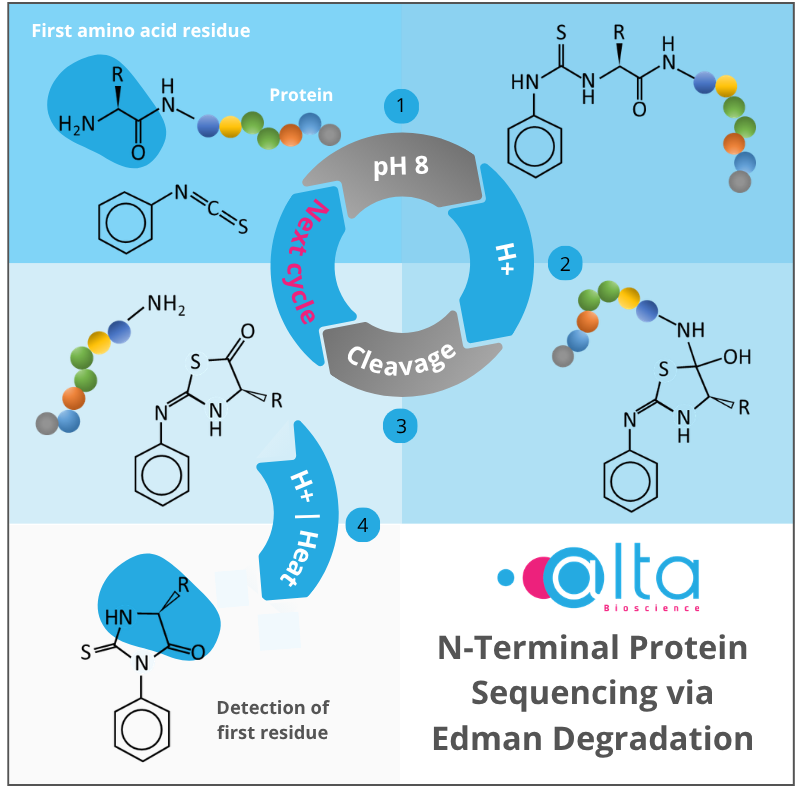
Automated N-Terminal Protein Sequencing – Edman Degradation: Step by Step Mechanism
- Step 1: The process begins by reacting the free N-terminal amino acid with phenyl isothiocyanate (PITC) under mildly alkaline conditions to form a phenylthiocarbamyl (PTC) derivative.
- Step 2: The peptide is then treated with acid, causing the N-terminal amino acid to cyclise.
- Step 3: The cyclic amino acid is then cleaved from the peptide as a stable phenylthiohydantoin (PTH) amino acid derivative, while leaving the remaining peptide intact.
- Step 4: The released PTH amino acid is separated and identified by high-performance liquid chromatography (HPLC).
- The process can then be repeated with the shortened peptide undergoing another round of labeling, cleavage and identification. In general, for quality control purposes, five cycles are usually sufficient, although it is possible to analyse up to 40 residues.
Protein Sequencing for Recombinant Protein Validation
When expressing proteins, the N-terminus can be a source of variability and may differ from the native protein sequence. For example, when proteins are expressed in Escherichia coli, ribosomal protein synthesis generally starts with the amino acid, methionine. Upon expression, this residue can be removed by host cell processing enzymes such as methionine aminopeptidase. However, approximately 40% of polypeptides still retain the initiating methionine.1 Whether it is cleaved or not depends on the identity of the proceeding residue in the sequence.
N-terminal methionine excision is not the only process that may alter protein termini. Additional variations can also arise following the removal of affinity tags. To facilitate detection and purification of recombinant proteins, peptide tags such as polyhistidine (His-tag) and FLAG tags are commonly fused to the N-terminus.2 Although enzymatic cleavage can be used to remove these tags, it may introduce additional residues or result in the loss of native amino acids.
As a result, recombinant protein expression does not always yield a single product and may contain a mixture of closely related isoforms.
N-terminal protein sequencing via Edman degradation is therefore a useful technique to:
- Analyse the N-termini and confirm the protein identity
- Verify the correct removal of tags
- Detect N-terminal modifications
Analysis of Qkine’s Recombinant Proteins
Samples for analysis can be submitted in a range of formats, including lyophilised solids, liquid samples or gel slices. Our method is highly sensitive and will detect all sequences present within a sample. Consequently, for unambiguous sequence determination, samples should ideally be highly purified. Mixtures of proteins or peptides may generate multiple overlapping sequence signals. Accurate interpretation of these chromatograms requires specialist expertise, particularly when analysing challenging samples or those containing more than one protein species.
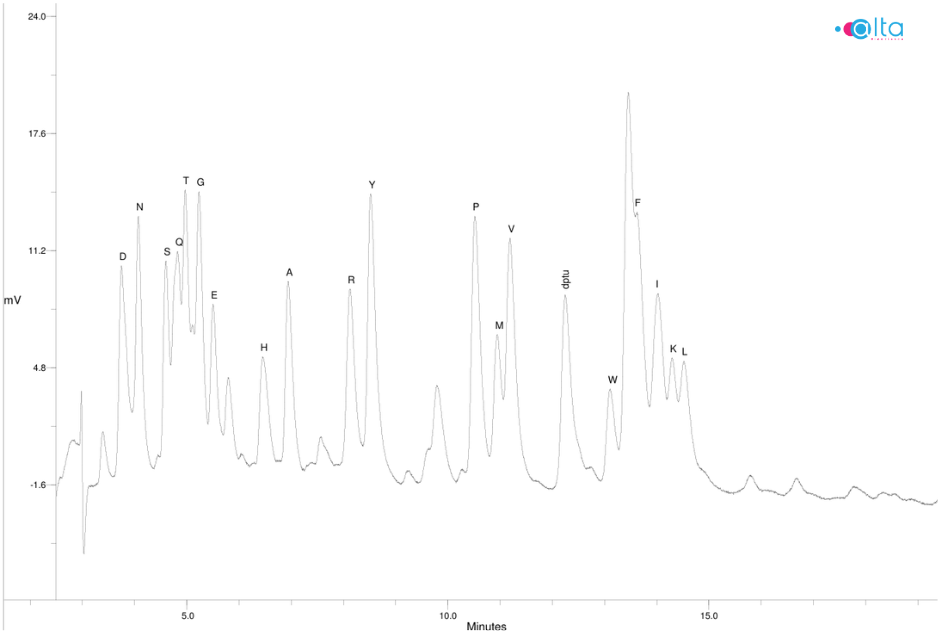
The chromatogram below shows an example of a Qkine sample analysed by Edman sequencing. Each amino acid derivative has a characteristic retention time, allowing it to be identified by comparison with reference standards.
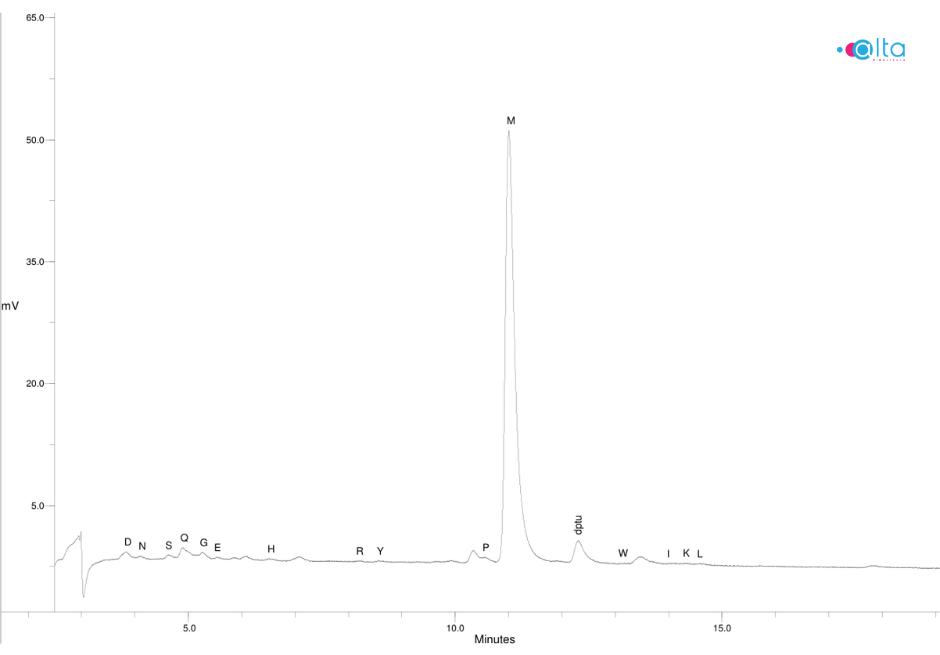
Adam Foxhall, Senior Scientist at AltaBioscience commented: “The chromatograms showed clean, well-resolved peaks consistent with the expected sequence. In combination with mass spectrometry, these findings independently confirmed the identity of Qkine’s proteins. Using protein sequencing for quality control increases confidence that the recombinant proteins are being manufactured consistently and meet the required standards.”
Conclusion
Characterisation of ancillary materials is essential to support the consistent manufacture of cell and gene therapies. Through N-terminal protein sequencing, it is possible to confirm protein identity, detect unwanted impurities and verify the correct expression of the desired recombinant products. This analysis enabled Qkine to verify that their growth factors were manufactured consistently and met the high standards required for use in cell and gene therapy manufacturing, where traceability, reproducibility and product quality are essential.
At AltaBioscience, we have supported biotech and life science companies for over 20 years with our ISO 17025:2017 accredited N-terminal protein sequencing service. As an independent partner, we provide accurate protein sequence analysis for all your quality control and research and development needs. If you would like to discuss a project or submit a sample for analysis, please contact us at info@altabioscience.com.
Download PDF
References
- Xiao Q, Zhang F, Nacev BA, Liu JO, Pei D. Protein N-terminal processing: substrate specificity of Escherichia coli and human methionine aminopeptidases. Biochemistry. 2010 Jul 6;49(26):5588-99. doi: 10.1021/bi1005464. PMID: 20521764; PMCID: PMC2906754.
- Zou, X., Liu, Z., Song, F. et al. Facile expression of proteins with desired N-terminal amino acid via an engineered cysteine protease domain. Commun Biol 8, 1165 (2025). https://doi.org/10.1038/s42003-025-08614-7